.png)
Baby on the Move: Top tips to making Baby’s Nursery safer
Every home, parent and child is different, so no-one has all of the answers. But one thing’s for sure – you just got used to baby smiling, cooing or bawling from wherever you last put them, when suddenly they get mobile. And it happens fast!
Rolling, crawling, sitting and ‘bottom bumping’ along, sofa surfing: however they get mobile, whenever they get mobile (children vary between two months and a year) now is the time to be vigilant.
According to ROSPA, the under-5s are particularly at risk of being injured in home accidents, notable falls threats to breathing. At 0-6 months they’ll often wriggle, kick, grasp, put things in their mouths to suck and roll over from where you put them. From six months to a year, they’ll often start to learn to sit, crawl, sofa surf, walk and put things in their mouths to eat.
Small children’s heads are proportionally much bigger than adults. They have a different centre of gravity so they topple more easily. And when they land, their heads take much of the impact.
So let’s take a look at what that means in the nursery.
Danger in everyday objects
Everyday items that can be risky for babies include:
· talcum powder which, if inhaled, can damage lungs
· nappies – torn off pieces can suffocate a child if swallowed
· safety pins
· plastic bags or wrappers
· pillows
· medications
· necklaces and longer ribbons (for example to keep a dummy (pacifier) attached) become hazards
· lamps (can burn as well as topple)
· cups of tea/coffee and glasses
· chairs (can overbalance)
· cleaning products
· toilets
Keeping these out of reach seems simple, but you still need to make sure you have what you need close at hand for the moments when you need to lie the baby down for changing nappies, preparing for a bath, for sleep or for clothes changes.
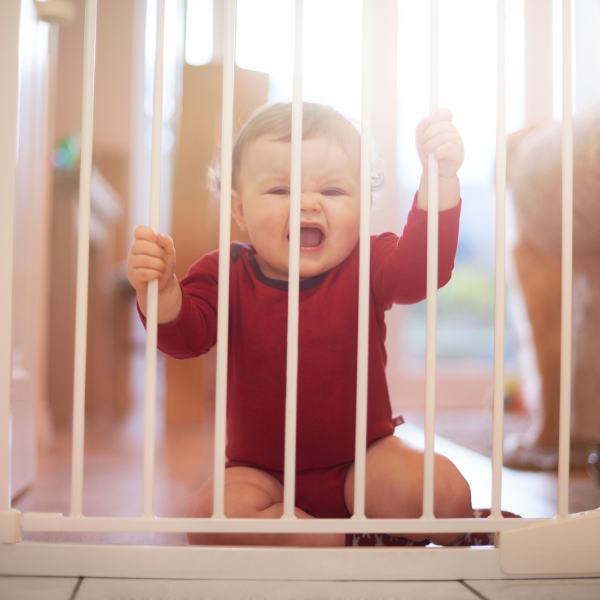
Doors are for going through. But if just outside the nursery door there’s a stairwell, or access to less safe places than the nursery, stair gates may be your best friend – on the nursery door as well as on the stairs. (in the UK alone, 35,000 children under four years of age fall down the stairs each year – and that’s just the recorded ones.)
And hinges on doors are popular places for little fingers to go - and get squished! The British Association of Plastic and Reconstructive Surgeons (BAPRAS) urges parents and carers to routinely use door stoppers and hinge guards in order to cut the estimated 50,000 children whose hands and fingers are crushed by doors each year.
Window guards on all windows above the first floor are well advised. Nationally, one child under five is admitted to hospital daily after falling from open windows or balconies.
Toy chests just became irresistible. Any lids should have safety hinges to hold them open.
And keep an eye on the cot – one minute they’re lying cooing at the ceiling, the next they’re big enough to pull themselves up and/or out. Now might be a good time to raise or remove mobiles from over the crib.
Changing Table
Falls from high surfaces can be serious. Being aware at all times is essential, but a changing station with sides/guardrails is going to offer more protection against unexpected, sudden wriggles, as is any safety strap.
Make sure supplies are within your easy reach, but out of baby’s reach. Don’t leave a baby lying unattended even for a moment at this age.

Clutter
The absolute best way to avoid accidents is to see the world as your baby does. Lie flat on the floor, face down, and then raise your head. What can you see? If we don’t want to child to have it, or it presents a potential hazard – especially if it’s brightly coloured, dangles, or is the right size to pop in a mouth - time to move it out of the way.
- Children use all of their senses to learn – and that includes taste. ‘If it fits in my fist, it fits in my mouth’ at this age.
- Keep small objects out of the way. This can be really hard if an older sibling has reached the ‘Lego’ age, but older siblings can be persuaded to be helpful and keep those kinds of toys in an area that baby is excluded from – their own bedroom or a space in the kitchen, for example.
- Things hanging from walls can seem irresistible to an exploring child wanting to pull themselves up. So look at the height of anything dangling, from bags to dressing gowns, from curtains to radiators.
- Similarly anything based on the floor can be used for ‘surfing’ or pulling them upright, so baskets, tables etc are similarly irresistible. Watch out for things that can tip over.
- Things under the bed may be out of sight for you, but for our little ‘rugrats’ they are at eye level, and perfect for bringing out the baby's inner explorer.
- Remove sharp-edged/hard furniture or use bumpers. Table edges are often right at baby’s head height.
More to help
This phase will soon be over – there is no need to dispose of things unnecessarily, just store away safely.
And if you need any help with that, easyStorage is always here to help. For a no-obligation quote, call 0800 061 4091 to speak to one of our storage solutions specialists, or use our online calculator.

.png)